
Packing for international travel can be a daunting task, especially if you’re not sure what to bring or how to pack efficiently. But with a little planning and organisation, you can make sure you have everything you need for your trip without over-packing or forgetting important items.
This ultimate guide will help you navigate the packing process and ensure a stress-free travel experience.
CHECK AIRLINE LUGGAGE ALLOWANCE
The airline’s luggage allowance will greatly impact the packing process. As you can see from my Ryanair Review post, Ryanair has several luggage allowances and sizes all with different prices. The practice of price-specific and size-specific luggage allowances are almost a standard practice with low-cost airlines.
It was Ryanair rather than Marie Kondo that introduced me to the concept of minimalism. Let’s just say it’s optional if your luggage sparks joy, but necessary for it to meet luggage allowance requirements.
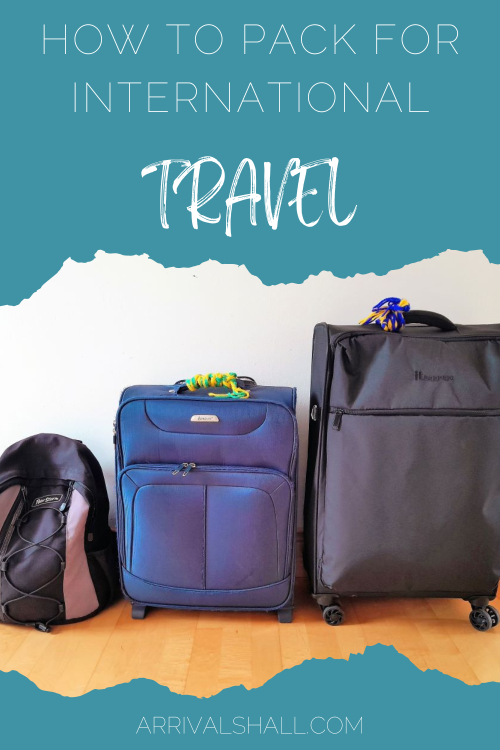
In the below picture, the small black rucksack will fit underneath an aircraft seat, the medium-size navy bag will fit into the aircraft cabin overhead storage area, while the large black suitcase will have to be checked into the hold of the aircraft. Some train companies specify luggage sizes but, in general, they are not as restrictive as airlines.

Determine how much you can physically lift. I find 20kg difficult to lift, but a bag that can carry that weight is the best option when travelling for two weeks. Luggage shouldn’t be a burden on your back or your wallet.
Also, the amount of liquids that you will be carrying as well as the airport’s ability to scan the liquids will determine where on the aircraft your luggage will be transported. Some airports have security scanners that don’t require liquids to be placed in 100ml containers, therefore allowing passengers to carry full-size toiletries in their hand luggage.
Even though your name will be on the airline’s bag label, as an extra precaution, affix a luggage name tag to the bags you place in the aircraft luggage hold.
You may notice that, in addition to my name tag labels, I have coloured ties on the handles of the medium and large size bags in the above picture. This is to identify my bags when collecting at the destination airport carousel, as it regularly happens that someone on the flight will have the exact same luggage as mine. It’s almost standard practice with Irish tourists to have ties in the colours of their GAA teams.
MAKE A PACKING LIST
One of the most important steps in packing for international travel is to make a packing list. This will help you stay organized and ensure that you don’t forget any essential items. Start by making a list of all the activities you’ll be doing on your trip, as well as any specific clothing or gear you’ll need.
Don’t forget to include toiletries, medications, and any important documents or travel documents you’ll need. Once you have your list, you can start packing with confidence, knowing you have everything you need for your trip.
If you travel regularly, it’s best to make a packing list template for items that you bring on every trip. This means you’ll have two packing lists: the standard template list and a new list specific to the trip you’re taking at that given time.

Have a look at my Pre-Travel Checklist post to see all the things you need to do before travelling.
CHECK THE WEATHER AND PLAN ACCORDINGLY
Before you start packing for your international trip, it’s important to check the weather forecast for your destination. This will help you determine what types of clothing and gear you’ll need to bring. It also gives an indication as to whether you’ll experience delays/cancellations en route.
If you’re traveling to a place with unpredictable weather (e.g. Ireland), it’s a good idea to pack layers that you can easily add or remove as needed.
Additionally, consider the activities you’ll be doing and pack appropriate clothing and footwear. For example, if you’ll be hiking, make sure you have sturdy shoes and comfortable clothing.
By planning ahead and packing for the weather, you’ll be able to enjoy your trip without worrying about being unprepared for the elements. But remember that you can buy extra items at your destination as local shops will be equipped for local weather.
However, bear in mind your physique versus the average physique at your destination. For the amount of times I’ve visited Spain, I’ve never found a trousers to fit my frame: I’m 5 feet 10 inches. I’ve had more success clothes shopping in Northern European countries.
PACK VERSATILE CLOTHING ITEMS
When packing for international travel, it’s important to choose clothing items that can be worn in multiple ways. This will help you save space in your luggage and give you more outfit options during your trip.
For example, a pashmina-type scarf can be worn as a fashion accessory, a head covering, or even a makeshift blanket in a chilly aircraft cabin or train carriage. A versatile dress can be dressed up or down depending on the occasion. Perhaps the runners you wear on board can be worn under multiple outfits.
Check in advance if laundry facilities are available. If so, then you can cut down on the number of clothing items to bring and simply wash them at your destination. Consider packing clothing that can be easily washed and dried in case laundry facilities are not readily available.
Bring specific clothes for certain day trips, if required.
Make provisions in case your hold luggage gets lost. For example, bring a change of underwear and top/t-shirt in your hand luggage. If travelling from a cold climate to a warm one, bring a pair of sandals in your hand luggage as well.
And as for the age-old debate of rolling clothes versus laying them flat in a bag: I’ve tried both methods and I think there isn’t much of a difference between either method, space-wise. If you’re transporting fragile items (e.g. wine), then it’s best to roll the bottle in a large item (e.g. towel) and roll other items into place around it to prevent excessive movement.
DON’T FORGET IMPORTANT DOCUMENTS AND ESSENTIALS
When packing for international travel, it’s easy to get caught up in choosing the perfect outfits and forget about important documents and essentials.
Make sure to pack your passport, visa (if required), travel insurance information, and any necessary medication in your hand luggage. Pack a universal adapter for your electronics and any necessary chargers in your hand luggage as well.
Carry hard copies of your itinerary details (e.g. accommodation bookings, pre-printed boarding cards) and important phone numbers in your hand luggage in case your electronic devices don’t work at your destination. In some cases, border control will ask you for these hard copies to prove that you are not engaged in criminal activity or that you are not being trafficked.
If you want to keep your luggage light, decant toiletries into smaller containers, if possible.
Make sure to pack a small first aid kit with essentials like plasters, pain relievers, and anything else for medical issues you regularly experience.
Check out my Tips for First-Time Flyers post for further information on hand luggage rules. For further topics, have a look at my Questions About Travel post.
Finally, if you forget any non-essential, there’s a possibility you’ll be able to buy it or an equivalent at your destination, within reason. This puts money into your destination’s economy and is one of the economic benefits of travelling.
Have you found this guide useful? Have you any other tips for packing? Let me know in the comments below.
 Arrivals Hall